Dementia
Mrs. FletcherDementia enters Roy Rafferty’s story as a swift, painful change in a familiar man, not as an abstract diagnosis: within months of his wife’s death, the sociable Senior Center regular loses his bearings and behaves in ways that put others at risk. His decline makes care a conflict between the affection he has earned and the limits of a community institution responsible for everyone who uses it.
Onset and Visible Decline
Before his wife died of a massive stroke, Roy had been healthy and lucid. He was one of Eve Fletcher’s favorites at the Senior Center: chatty and friendly, he greeted people like a politician campaigning for reelection, shaking hands and asking after their grandchildren. After the loss, his condition worsened rapidly over roughly six months, alarming those who had known his former self.
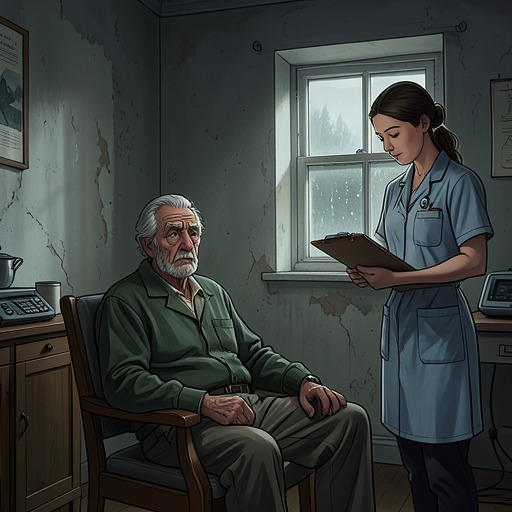
The change appears in small failures of recognition as well as in disruptive behavior. When Eve tries to discuss an incident with him, Roy asks whether it is lunchtime, although he has already eaten, and then cannot recall what he has done or whether he has done anything wrong. His face tightens with futile concentration; beside him, his son George Rafferty watches apprehensively. The contrast between Roy’s old warmth and his present confusion makes the decline legible through encounters that might otherwise look like mere misconduct.
Conduct, Care, and Exclusion
The decline became impossible for the Senior Center to treat as private confusion when Roy entered the women’s room again and exposed himself. He had also invited Evelyn Gerardi, who relied on an oxygen tank, to join him; Eve spared George the more humiliating details when she explained what had happened. The incident followed an earlier episode in which Roy, during a ride home from the supermarket on the Elderbus, had stood on his seat and urinated out the window. That earlier behavior had already brought George to the Center, though the account does not explicitly identify it as part of Roy’s dementia. Together, the episodes show how Roy’s loss of judgment affected other people in shared public spaces, not only his own memory.
Eve’s decision to bar Roy from the Center was shaped by both personal affection and institutional responsibility. She reminded him that staff and members had valued his kindness over the years, but told him he could no longer attend. George protested that his father was being expelled and asked for another chance. Eve answered that they had already given him one, that the situation would not improve, and that Roy needed a nursing home rather than a community center. Her boundary was not a declaration that Roy had become a different person in every respect; it was a response to conduct the Center could not safely accommodate, even as his former warmth remained part of how its staff remembered him.
Death and Retrospective Meaning
Roy died only a month after Eve barred him from the Senior Center, a timing she could not have known when she made the decision. She did not conclude that she had acted wrongly: as the Center’s administrator, she believed she had no choice. Yet at his wake, the memory of excluding a sick old man who had so little time left made the necessary boundary feel cruel and pointless in retrospect. Her grief came from the collision between responsibility and affection: she had protected the Center’s members, but had also caused pain to someone whose kindness she remembered.
The crowded viewing room testified to a life that dementia had not erased. Mourners filled the parking lot and gathered in line beside Roy’s open coffin, honoring his longstanding ties to Haddington, civic memberships, successful plumbing career, and the genuinely nice man he had been before his decline. Eve sat near the Senior Center regulars, including Evelyn Gerardi, whom Roy had subjected to unwanted advances. Her presence brings the consequences of his behavior into the same space as the community’s mourning, without reducing either Roy’s history of kindness or the harm of the incident to the other.
Aging, Care, and the Limits of Exclusion
Roy’s expulsion also sits within the Senior Center’s broader tension between serving older adults and deciding who can safely take part. Its spacious, wheelchair-accessible bathroom was used by people managing insulin injections, ostomy pouches, digestive problems, and the need for privacy. That range of needs shows the Center as a shared space shaped by practical accommodations; Roy’s conduct, however, exceeded what that setting could manage, and Eve said he needed a nursing home.
The debate over Margo Fairchild’s talk gives this boundary a wider social resonance. Margo had assumed that older people were too fixed in their views about gender to change, and that it was better to wait for them to disappear. Eve challenged her for applying to seniors the same dismissive logic used against LGBT people, emphasizing that older adults were vulnerable and stigmatized, and could still shape their families and communities. That argument does not undo the need to protect people at the Center from Roy’s behavior. It does, however, sharpen the distinction between excluding someone as a supposedly lost cause and recognizing that a particular institution cannot provide the care a person now requires.